Subscribe to platformB Newsletter.

»Right now, we are united by a profound pain that permeates every textwhether voiced and named, or present as a figure of silence«

Six years after the suppression of large-scale protests against fraudulent elections, the situation with human rights in Belarus remains unprecedented. The crackdown continues in this countryin recent months also directly targeting publishers and distributors of books in the Belarusian language. According to PEN Belarus, after 2020, five independent Belarusian publishing houses faced liquidation and two more were forced to suspend their work triggering an institutional exodus. Today, around 20 publishing initiatives operate out of Belarus, actively searching for ways to remain committed to their mission to preserve the culture and language, classified in 2010 by UNESCO in its Atlas of the World’s Languages in Danger as vulnerable.


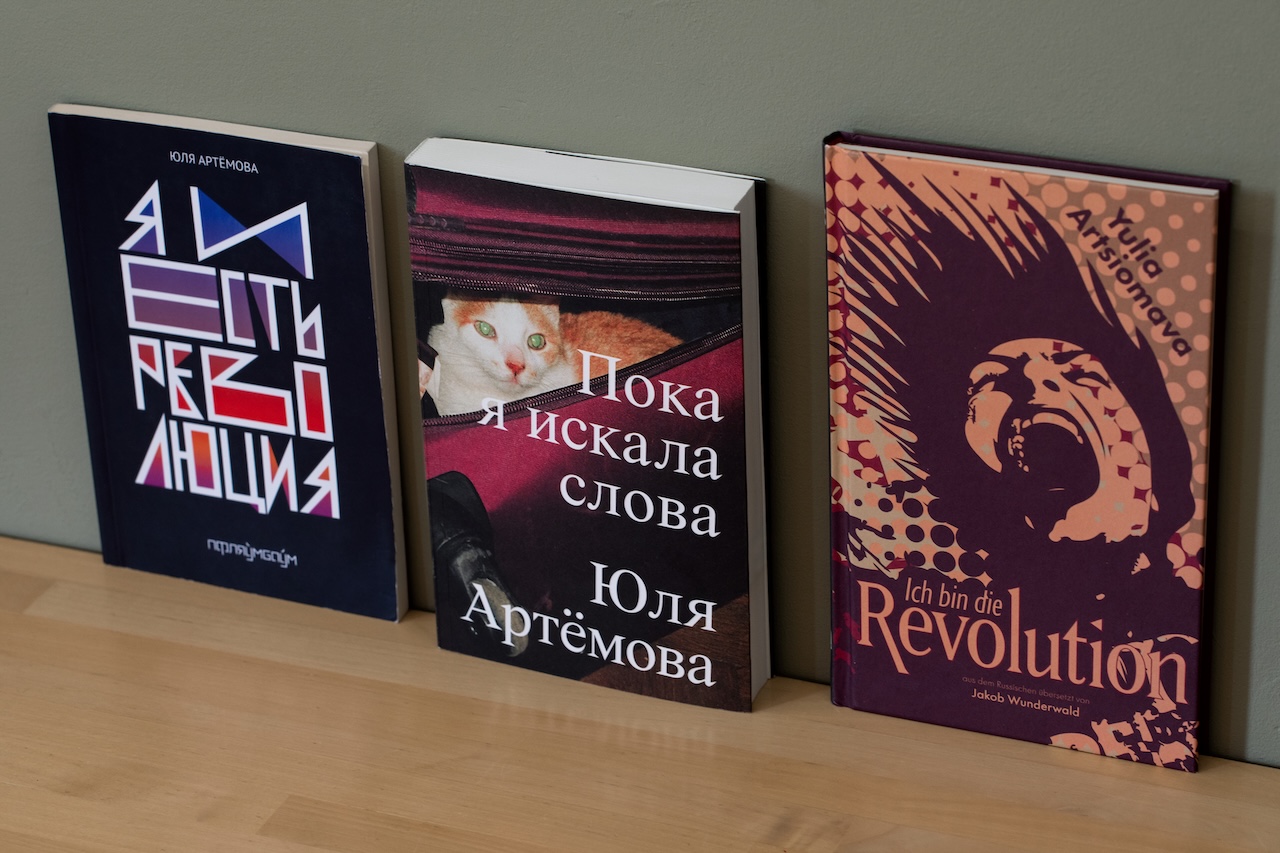
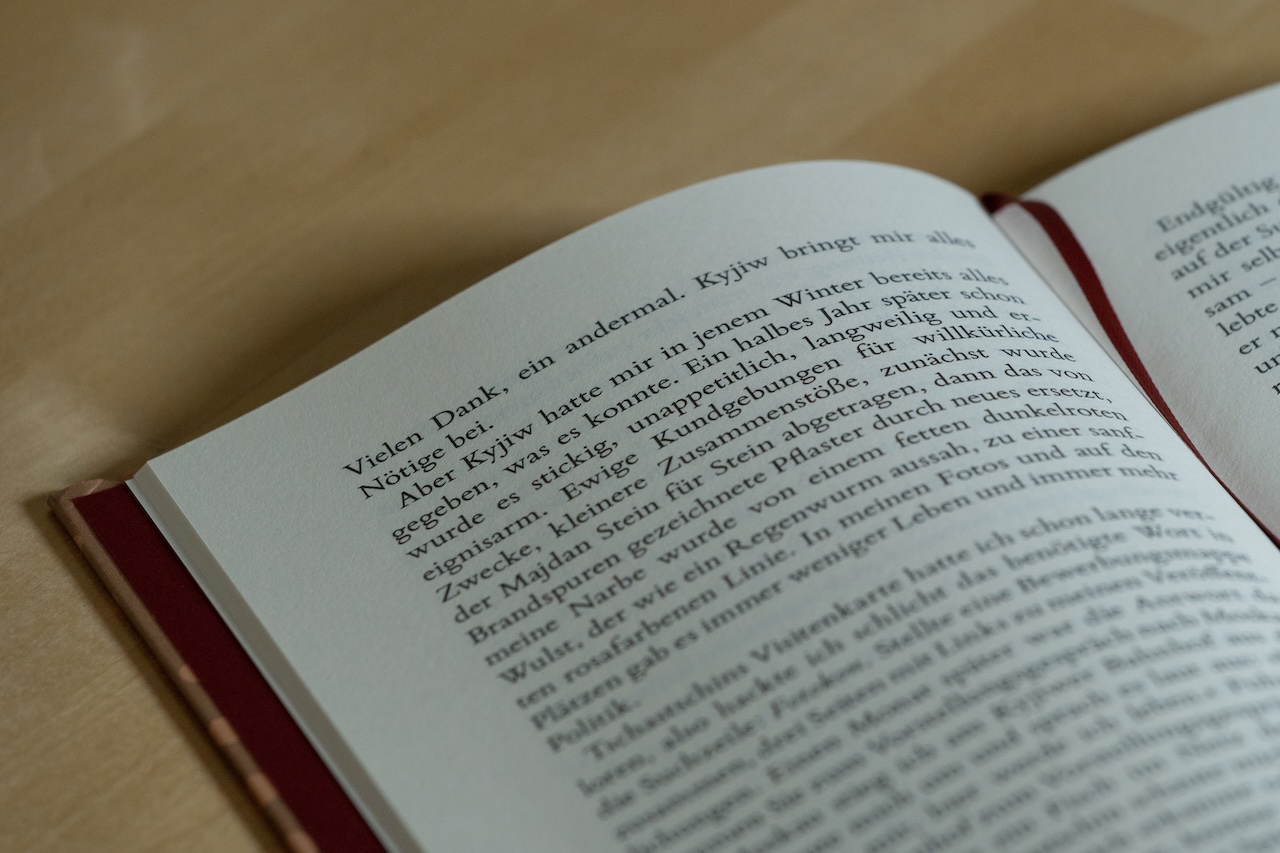
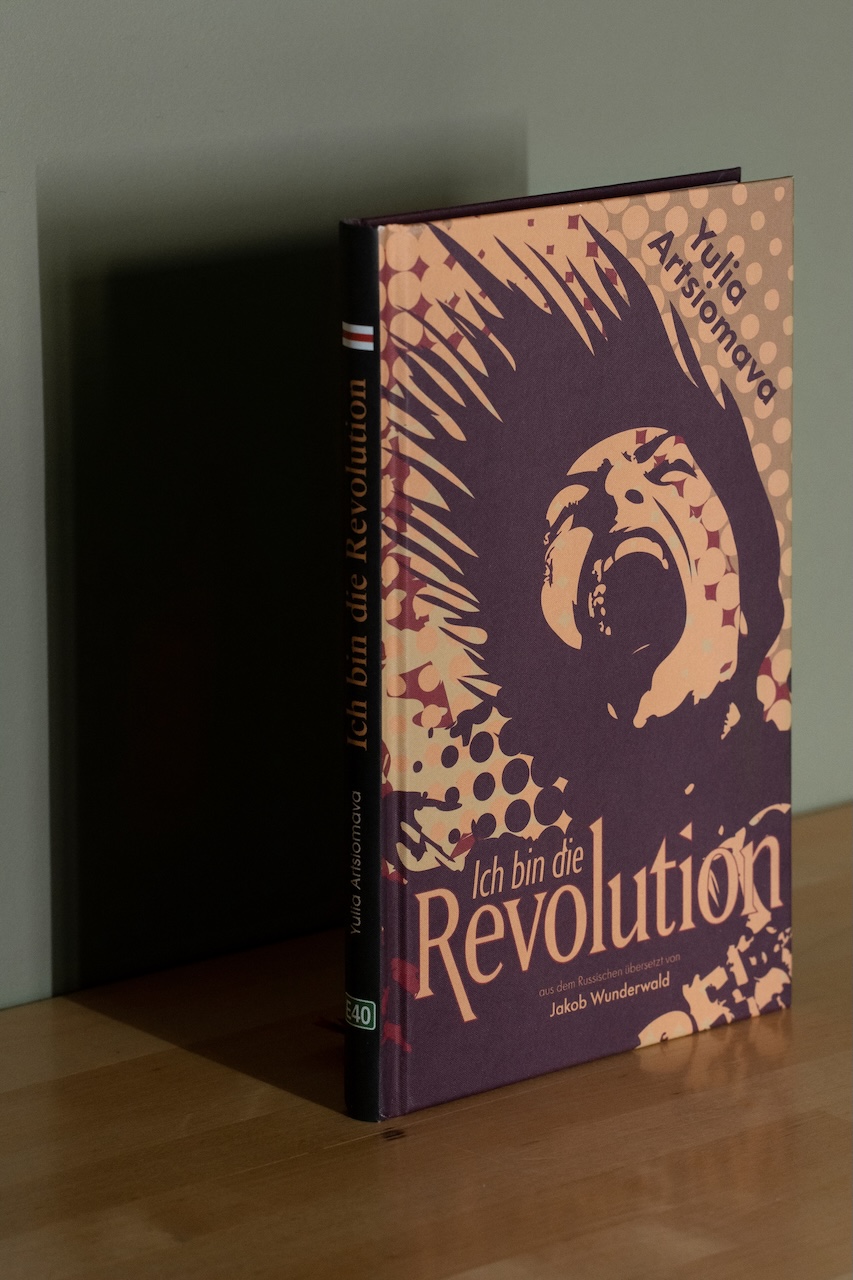
However, despite massive efforts of exiled and newly formed publishing houses, Belarusian literature is still not widely represented internationally. In a way, the world is arguably only starting to discover it and every new translation of a Belarusian author into a foreign language is an event worth mentioning. One of the recent translations into German is a book by Minsk-born writer Yulia Artsiomava »Ich bin die Revolution« (Verlag Friedrich Mauke KG, translatorJakob Wunderwald), so platformB decided to contact its author to talk about writing in exile, Belarusian publishing landscape, and future of Belarusian literature.
Olga Bubich

I remember reading your book after receiving it by mail in Batumi in 2022 where I was living then, while your family was in exile in Ukraine. My first impression was that of surprise: I hadn’t known you wrote it in 2016, or that the word »revolution« in the title wasn’t linked to Belarus, but to the Maidan and, in a way, to the protagonist’s inner stateher attitude toward the world and herself.


What does the word »revolution« mean to youas a term, perhaps as a life philosophy, or even as an emotion? And how has your attitude toward its usage changed since 2016, given the shifting political landscape in the region and the changes in your own physical and linguistic geography?

Yulia Artsiomava

Latelyand I don’t know whyI’ve felt a growing fear, a genuine dread, of the elemental forces of nature. At one point, I truly grasped how defenseless a human being is against nature, the moment it revealed its force and made me feel like a speck of dusttiny, weightless, insignificant. Once in the mountains of Georgia, I had a really intense and deep feeling of my own insignificance and mortalitynot mortality as such, but in that specific moment: I realized that if I stumbled, made a wrong move, or if the weather suddenly turned worse and a storm broke out, I could die. Not sometime in the future, but right then and there.


Revolution to me is a similar elemental force, only a social one. It starts independently of you, sweeping you up even if you don’t want it to, even if you resist or try to stay on the sidelines. But it just lifts you and carries off. We tend to think of ourselves as self-aware individuals who possess agency, principles, and knowledge, yet lately, I have become a staunch fatalist: when you really think about it, there are, in fact, not so many choices people  have.


The 2020 Belarusian revolution was that very force, which swept me into emigrationfirst to Ukraine, then to Poland. Of course, it was not merely a physical relocation from one place to another. It also triggered profound internal changes. And  the revolution ultimately transformed both my life and who I am. That is why the title of my book resonates so deeply with me: I may not »be« the revolution, but it rolled over me like a steamroller, leaving an indelible mark. Yet, by nature, I am inclined toward evolutionary growth; I am very consistent in my views, and I cannot say that my principles or worldview have changed significantly since my teenage years. So, the turbulent political events unfolding in the region are something I experience as concerning me personally and at a very deep level.

Olga Bubich

The situation in Belarus today is often described as unprecedented: over 160 books in the country are designated as »extremist,« 258 books (including alternative »classics« like those by Irvine Welsh, Ryu Murakami, and Jeffrey Eugenides) are banned, five publishing initiatives have been liquidated. Alongside domestic repressions, a number of publishing houses have managed to resume operations in exilethough, predictably, facing significant difficulties and limited print runs.


But what I have also noticed, many of these books often turn into objects of solidarity: people buy, photograph, and present them to friends, yet the texts themselves far less frequently become the subject of a broader literary, intellectual, or critical discourse. There is a near-total absence of reviews, analytical pieces, or discussions that would situate contemporary Belarusian literature within a broader European context. Do you share this impression? Who, in your view, is the reader of Belarusian literature today? And what needs to happen for Belarusian literature to cease being perceived as a testament to a political era and instead become part of a shared European literary dialogue?

Yulia Artsiomava

I agree that Belarusian books have become artifactsobjects of interior decorationrather than sources of thought or discussion. In fact, that is what they have become for me, too. I don’t buy books to read them immediately; I buy them for my shelves, simply to know I have them. For some reason, accumulating books is important to me. Perhaps because I perceive the world through text.


The answer seems simple to me. When we talk about prose or essaysrather heavy genrestheir task is not merely to react but to reflect, methodically processing what is happening around us into something meaningful. And I get a feeling that the Belarusian reader today isn’t looking for such meaning, but for something elsecalmness, solace, or a way to give shape to emotion.


That is why what is being written now isn’t meant for today’s reader. I see it as preserving the era. It is addressed into the future. Other genres are taking center stage today: those capable of reacting faster to our reality, reflecting rather than interpreting it, allowing the pain to pour out. For me, this is primarily music or visual art, since they work more with the imagery than with abstract meaning.


Belarusian literature currently exists in a vacuum, without a readership. Its books are left to fend for themselves. But this is a long game. I believe the situation will gradually change in a few years when those dust-covered books are finally taken off the shelf and read.


For literature to cease being politicized, we ourselves must become depoliticized. Literature does not emerge from a vacuum; it is created by usthe authors who stayed in Belarus, silenced and voiceless, and the authors who left and are forced to survive in exile, stripped of the ground beneath their feet and a vision of the future. We speak and write about our pain, resulting in two distinct literatures on either side of the border. I wonder how we will eventually stitch them back together, given thatwhether we left or stayedwe are largely talking about the same things.


It seems to me that we often try, with a painful obsession, to prove our »Europeanness«whatever that might actually entailbut literature is an utterly honest medium; it tolerates no falseness. We need to write about what demands to be written. Right now, we are united by a profound pain that permeates every textwhether voiced and named, or present as a figure of silence.

Olga Bubich

What kind of literature do you feel is missing now? What topics, in your view, are rarely written about today, even though they have long demanded reflection?

Yulia Artsiomava

I would probably slightly rephrase the question: it’s not so much a specific type of literature I’m missing, but rather a particular kind of reading experience. Framed that way, what I miss is that long-forgotten feeling of diving headfirst into a book, unable to tear yourself away until you’ve finished it. I miss truly gripping literature. Or perhaps I’ve changed so much myself that no book can truly captivate me anymorenot with everything happening right outside our windows, and all over the world.


As for topics, I’m currently going through a crisis of national identity, so naturally, I’m constantly looking for something on that subject. It might be a mistake to think that if you have questions, you’ll find answersor even just cluesin books. Yet, whenever the topic of Belarusian national identity is raised in contemporary literature, it tends to be portrayed in a one-sided way: the village, marshes, old women whispering incantations, a return to roots and nature.


Yet the identity of a modern person is incredibly complex; it is made up of many sub-identitiesincluding the nationaland these sub-identities require a more nuanced approach. It’s not just about embroidered towels, straw »spider« mobiles, and grandmothers’ rituals. This is a problem that concerns not only literature, but entire contemporary Belarusian culturethis simplification of the national and its reduction to mere attributes of folk culture, seeking oneself in the past and remaining fixated on it. At the same time, the national aspect seems to exist in isolation from the universal human experience; it comes across as somewhat archaic, kitschy, and two-dimensional. I see nothing authentic in this: while rituals and traditions were part of our grandmothers’ daily lives and reality, for the modern person they are often merely a cargo culta matter of blind imitation or odd attempts to somehow modernize them.

Olga Bubich

Which books by contemporary Belarusian authors would you like to see translated into other languages and why? What kind of Belarus might European readers discover through them? And which Belarusian texts from those recently read truly surprised or moved you?

Yulia Artsiomava

I don’t really like naming specific authors, because I wouldn’t call myself an attentive reader of contemporary Belarusian literature, so I can’t claim to be objective. But I’m always delighted to hear the news of Belarusian authors translated into other languages. I don’t want Belarusian literature to appear monolithic. I want a variety of books to be translated: serious and light, prose, poetry, or fairy tales.


I would really love to see a translation of Tatsiana Zamirovskaya’s novel *Smerti.net* (literal translation from Russian »Death.net«). It is a powerful book about death, texts, and memory, a crucial book about us, a novel that predicts and precisely describes that state of »in-between,« a kind of death that many people experience while in emigration. Tatsiana has a rather interesting, distinctive style; her language isn’t just a tool, in essence it is an artistic device. I think conveying the uniqueness of this novel in another language would be an interesting challenge for its translator.


As for a text that surprised me, I’d point to Masha Gulina’s book *Letela belaya ptitsa* (A White Bird Flew By), a collection of travel stories. It is the work of a truly happy person, with no suffering, anguish, or loss, yet it isn’t emptyit feels tangible and vivid. This book is highly atypical for Belarusian literature: we know how to write about pain, but we lack the words to speak about joyand speaking about it in a way that is interesting and captivating is a real challenge. Fortunately, Masha found those words and that tone. This book of joy seems all the more remarkable now, given how much unspoken, unprocessed trauma we carry within us.

Olga Bubich

The Russian-language blurb for *I Am the Revolution* describes it as a »very sincere, very feminine, andin a good waya very angry story.« Do you recognize yourself in that description now, nearly ten years later? Or would you perhaps choose completely different words for your book now?

Yulia Artsiomava

If I were writing this book today, I would choose a different form and style; I would have told the story differently. For me, this novel is really a bit like a time capsule with memories from another life. It is a text that belongs to its own time, not the present. Unfortunately, the publishing process is long and cumbersome, so the book came out later than it should have, in my view. That only becomes apparent with the passage of time. Back then, it seemed as though the »revolution« on the cover and the revolution on the city streets would resonate in harmony.


I am currently writing a new novel; the first part is about to be released (and by the time this interview is published, it likely will have been). It is a work of autofiction about my own emigration and the three years I spent living in Ukraine. The words from that blurb could apply to this text as wellit is also a very sincere, feminine, and angry story; perhaps even more sincere and angry, given that I essentially repeated the path of the protagonist from *Revolution*: I emigrated and tried to pursue my creative work there. I am glad that these books turned out to be so harmonious and consistent; it wasn’t planned that wayit just happened as a result of circumstances.

Olga Bubich

If someone who knows nothing about Belarus buys and reads »I Am the Revolution«, what would you like them to take away from it? What thoughts, emotions, or questions, directed at themselves or at Belarusians?

Yulia Artsiomava

I would like the reader to feel curious and ask themselves, »Which other Belarusian authors can I read?«

The Book »I am a Revolution« is available online hier. Publishing houseFriedrich Mauke KG