Subscribe to platformB Newsletter.

»I Feel Like a Stone Brought from Another Land«

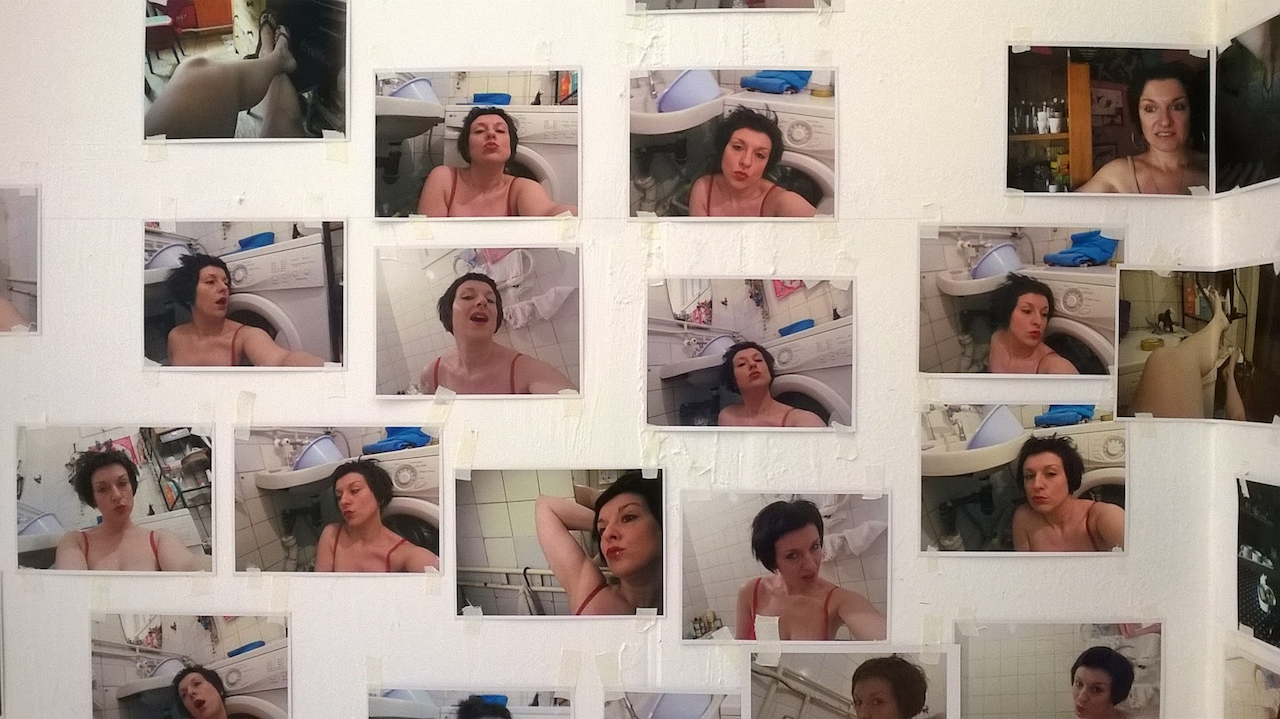
From the ongoing series “I Want to Be as Beautiful as You” (2011-now), Antanina Slabodchykava

What happens to an artist, when social and political conditions they used to confront daily shift into a new reality that promises equality and freedom, but at the same time alienates?


Stripped of the status, context, and political tension that defined her twenty-five years in Minsk’s nonconformist art scene, Belarusian visual artist and educator Antanina Slabodchykava navigates the exile system of coordinates within the disorienting transit spaces of Dresden and Berlin. In a conversation for PlatformB, she speaks about Berlin as »The Fifth Element« train station and herselfas a stone brought from another land or a cutout from a family photograph in search for a different background she might become a part of.

Olga Bubich

My first associations with your artwork are »freedom,« »anger,« »artist,« »mother.« But there is also one concept that binds them all together: »protest.« I have always felt that your positionboth artistic and civichas been that of a challenger. You boldly confront institutions, whether it is the Academy of Arts or the Minsk Palace of Art with its pretentious »salon-style« pseudo-art, or deeply ingrained stereotypes regarding parenthood and gender.


With this constellation of meanings in mind, I’d like to start with this question. How do you liveand survivein exile, carrying all that moral and emotional baggage? Do you still manage to find ways to protest in Dresden and Berlin? Against what, or for what?

Antanina Slabodchykava

That’s a fascinating observation. I agree that my work is linked to protest in one way or another. But I prefer to call it something else: resistance. I am convinced that by resisting the dictates of accepted standards, we can create alternative ways of perceiving people, situations, behaviorsand life itself.


For me, exile has been a series of discoveries. One of them is related to the observation that back in Minsk I had always been resisting against something, starting from my student years at the Academy of Arts. To defend my diploma, I had to prove I could draw and paint traditionally. So, during my final semester, I produced realistic oil paintings and classical nude studies to demonstrate I possessed the technical skills. It was the only way to get my professors off my backto be allowed to make art that actually expressed who I was, using a visual language that matched my vision. It was a conscious strategy.

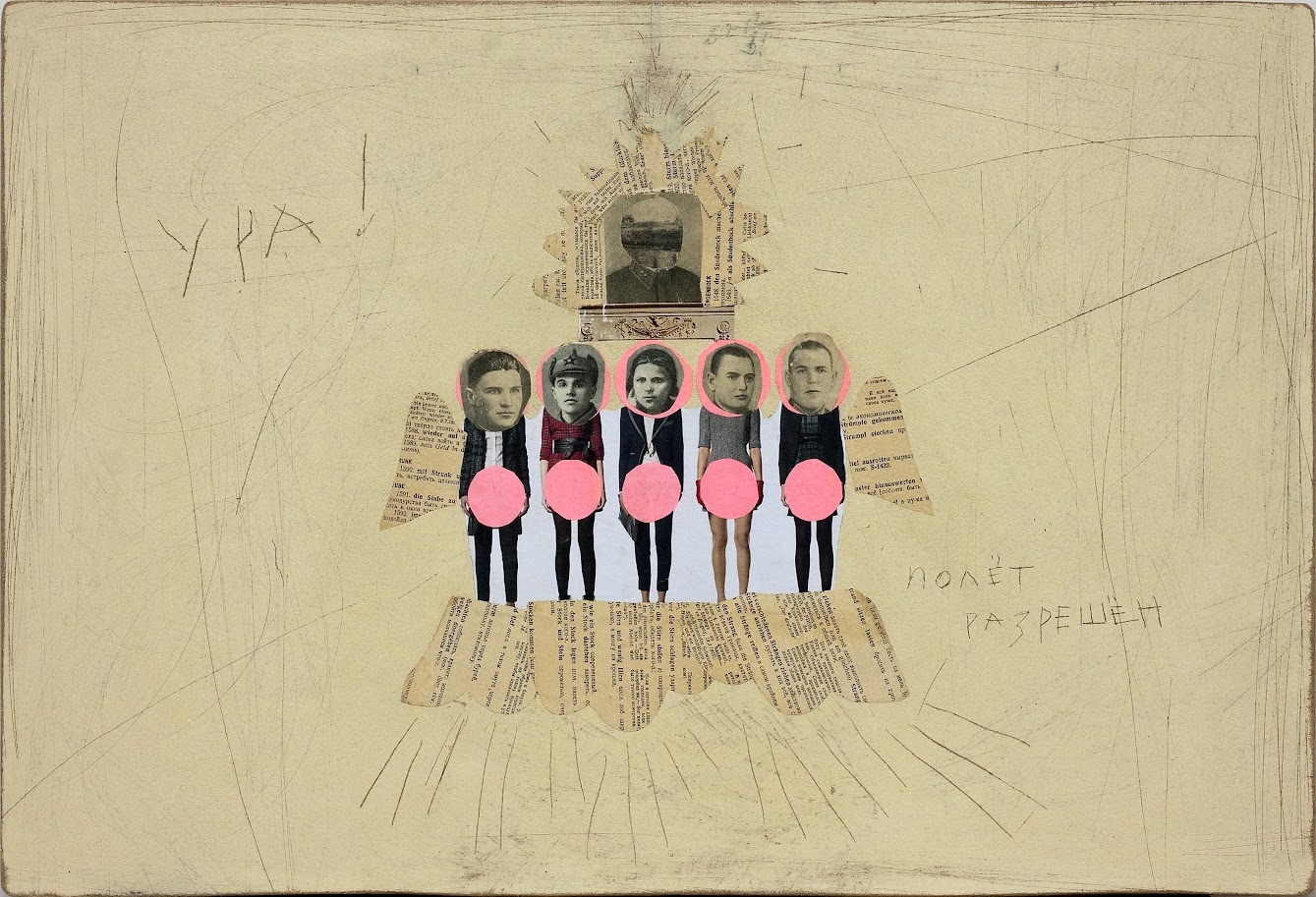
From the series “Est ist da” (2012), Antanina Slabodchykava
From the series »Est ist da« (2012), Antanina Slabodchykava

ANTANINA

So, over my twenty-five years in Minsk, I constantly found myself inside a nonconformist narrative that we, Belarusian artists, inherited from the Soviet era. When I arrived in Germany in 2023, I realized that I had been conditioned to always be »against« or »for« something. In Belarus, it was not my deliberate goal; I simply did what I wanted, but my behaviour inevitably provoked a reaction. All I was doing was standing up for my desire to make the art I believed in. That is how my artistic mentality was formed in Belarusin a risky, controversial opposition. On the one hand, it brought a lot of pain. On the other, it supplied an incredible amount of energy. I felt I was always on the front lines, always challenged.

Olga

How did your exile to Germany change this perception?

Antanina

I found myself plunged into a kind of abstract freedomthe mythic freedom you hear so much about. But at the same time, as a personality, I felt I ceased to exist. Everything and everyone you simply doesn’t  care! Your new surroundings couldn’t care less about who you are and what you do.


Whatever one might say, but back in Belarus I had a status. Even though I never actively sought it or defined it for myself, it was there. I existed, and my name existed. Here, for objective reasons, I have been stripped of all that.


It’s extremely disorienting: you exist, you possess power, energy, and skill… but at the same time… you are invisible. I have a metaphor to describe this feeling. Trains traveling from Belarus to the European Union have to be transferred to different tracks because of a difference in railway track widths. Belarus uses the former Soviet standard track gauge, while in the EU they have the standard international gauge. To fix this, trains undergo a mechanical process called a »bogie exchange« at border stations.


This is exactly how I feel. On the surface, you have this new realityneighbors walk their dogs, see you, and greet youbut fundamentally, you don’t exist.

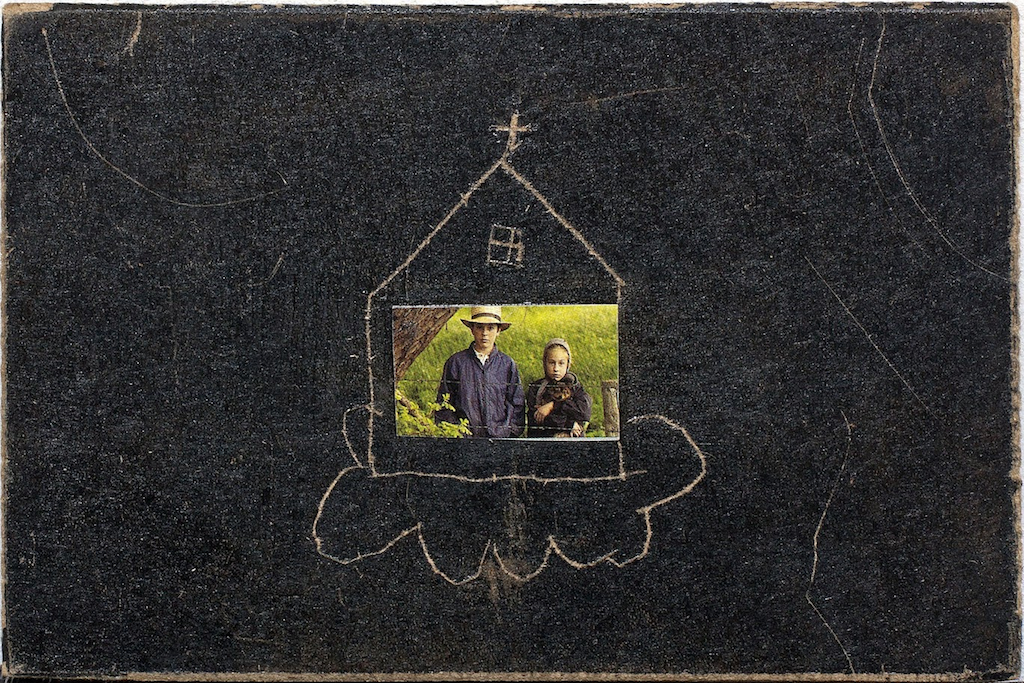
From the series “Est ist da” (2012), Antanina Slabodchykava
From the series »Est ist da« (2012), Antanina Slabodchykava

ANTANINA

So, when people say everything is relative, they are really talking about the experience of displacement. You learn a great deal about yourself, your stance, your civil position, and your values, when put into entirely new conditions. But I have also come to realize how critical it is to preserve my own artistic focus, my unique way of seeing the world. The difference is that in my home country, this focus was a political statement. Here, in Germany, it is largely subsumed under the LGBTQ+ paradigm, viewed as just one of many coexisting opinions.


I have also realized something vital for a female artist: it is essential to be looked at. Back in Belarus, negative feedback was often enough. A circle of like-minded colleagues naturally offered positive, supportive reactions, but overall, the friction was enough. I felt seen and I was being looked at. In exile, I experience a vacuum.

From the ongoing series “I Want to Be as Beautiful as You” (2011-now), Antanina Slabodchykava
From the ongoing series »I Want to Be as Beautiful as You« (2011-now), Antanina Slabodchykava

ANTANINA

My body was the first to react to this emptiness. It decided that the only thing I can do was to look at myself, and to be independent in that gaze. I can look at myselfa search now documented in my ongoing project »I Want to Be as Beautiful as You«, a series of self-portraits reflecting on aging, appearance, and self-image. Deep down, I am the only someone who would always be by my side… I cannot demand the world to look at me, and neither can I demand it from my partner. Do I really want that gaze handed to me as »a gift« or an »honorarium« I have allegedly earned? It was as if I suddenly recognized where my true »contours«my physical boundariesactually lay. I wanted to honestly look at myself, without irony or double standards. Just to like myself, at the end of the day. To feel comfortable and accepting of who I ameven though I do think that the word »acceptance« is terribly overused these days.

OLGA

How would you describe your period of adaptationin your case even not to one country, but two? You arrived in Germany supported by the Martin Roth Initiative, living first in Dresden, before moving to Berlin.

Antanina

I’ve been living in Germany for four years now, and the culture shock was profound. I’d even say that it is not yet over: I am still adapting, and it remains difficult and strange. If we view culture shock not just through a professional lens, but look at life itself as a cultural act, I would say I experience everything very intensively.


I was surprised by how alien everything could feel, and by how urgent it became for me to have something that was truly mine. I had never previously viewed life through a binary opposition of »mine« versus »foreign«. Here, however, that distinction became a major revelationone I am still trying to process, hard as it is.

From the series “Est ist da” (2012), Antanina Slabodchykava

From the series »Est ist da« (2012), Antanina Slabodchykava

ANTANINA

I remember my impressions of a German language school in Dresden, when I suddenly realized that my new classmatesa Chechen, a Libyan, a Syrianwere all adults, professionals, who, like me, had been forced to abandon their homes for different reasons. One was a gardener, another an electrician, and I was an artist. Yet all of us were equally alien to one another and to this new reality.


Another memory I would like to share is that of me arriving at Berlin Central Station late in the evening to take a train to Dresden. Looking around I suddenly noticed how different, bizarre, and out-of-place all the passengers appearedall of us suspended at this transit hub, feeling lost about our eventual destinations. It was like the space station from »The Fifth Element«!

OLGA

Could you elaborate on that distinction between »mine« and »someone else’s«? Does this shift in perception also have to do with the Soviet past, when in Minsk all felt »shared,« belonging simultaneously to everyone and no one?

ANTANINA

When I arrived here, what surprised me most was how frequently I found myself reflecting on what nourished me as an artist and why in general I experienced such intense nostalgia and sadness, what truly constituted my identity and how risk had shaped my visual language, about what my memories were made of….


Of course, there are tangible things I missmy home, its physical walls, the peoplebut I also realized there was something intangible missing. Literally the air that used to fill meair I had always taken for granted and never consciously noticed. That, too, is a part of me: the air of home.


In contrast, I came to realize that in a foreign environment, even the air and the sky feel alien. They are unfamiliar, and in that sense, they didn’t belong to me. I have no history with this place; we have no shared memories.

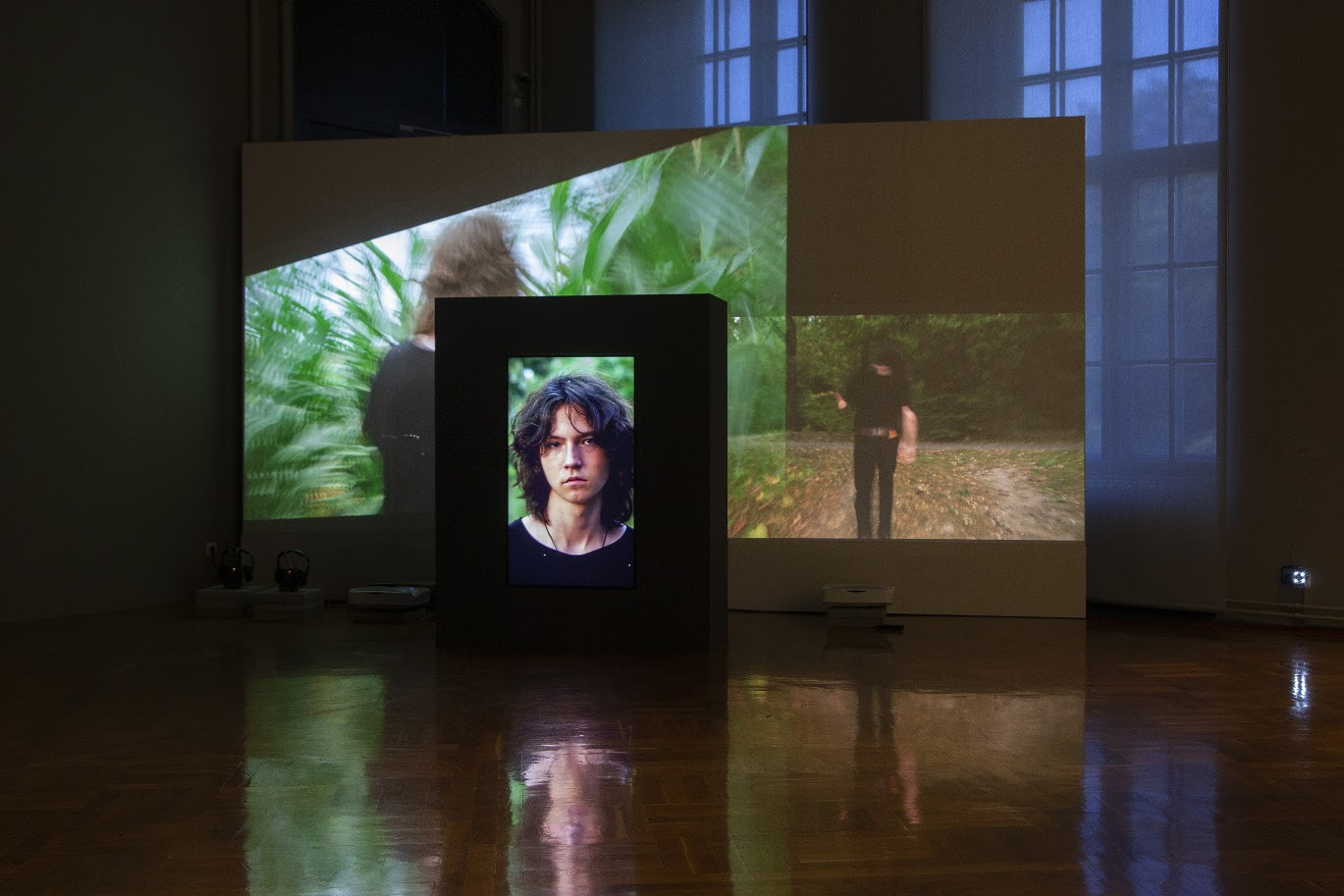
An installation view from the exhibition “Café Belarus II: Kassandra Complex Kassandra Komplex” held in Japanisches Palais in September-November 2023
An installation view from the exhibition »Café Belarus II: Kassandra Complex Kassandra Komplex« held in Japanisches Palais in September-November 2023

ANTANINA

That was when, turning to my thoughts of home, I understood that in that now unreachable place, all had truly been mine. I used to think that concepts of ownershipwhether of a homeland, a territory, or a housedidn’t matter much to me. But becoming an émigré flipped that dynamic completely. Suddenly, the world was sharply divided into »mine« and »alien.« I don’t think I fully grasped that something was mine while I was living in Minsk, it didn’t really matter to me. But only after finding myself somewhere elsein a foreign landdid I begin to realize that »mine« wasn’t here. It was another profound revelation. I felt like a stone brought from another land.


What a strange thingthis love for the air of home; it simply appeared in me and started growing… Perhaps it just takes time for a new love to a new place to take root.


I’m also curious to see how this heavy experiment will unfold. I’m interested in observing the changes within myself: how this »foreign environment« affects my art and my perception of self. I often reflect on our right to claim something alien as our own, and whether a foreign land can ever become home. On top of that, there is a constant flow of new information. We lived in Dresden for three years, and I’ve been in Berlin for a year nowand the mentalities, social structures, and regulations are completely different. You are constantly operating within a system of new constraints. It feels very new to me, as I’ve never been accustomed to living by so many rules.

OLGA

That really resonates with me as well. In my own experience, I see an overwhelming number of rules in areas where they aren’t needed, alongside the absence of such where they might actually be helpful. It’s as if, in addition to a new language, culture, city, and so on, there’s a border layera social codethat feels almost impossible to master because it’s constantly changing.

ANTANINA

Exactly. This new language dictates specific patterns of behavior, listening, and interaction, directly impacting your ability to navigate daily life.


Naturally, you feel like you have to relearn everything from scratch. You pick up a children’s book to learn basic vocabulary, but simultaneously, you are learning institutional rules: where to go, what to do to secure paperwork, how to ride a bike in traffic, how to sort trash or to return recycling bottles. It’s all new, and it carries immense stress. And all of this combined creates a surreal sensation of inhabiting someone else’s lifeas if I am living inside someone else’s story.


In the end, it turns out that my real life exists only in my head and in my art.

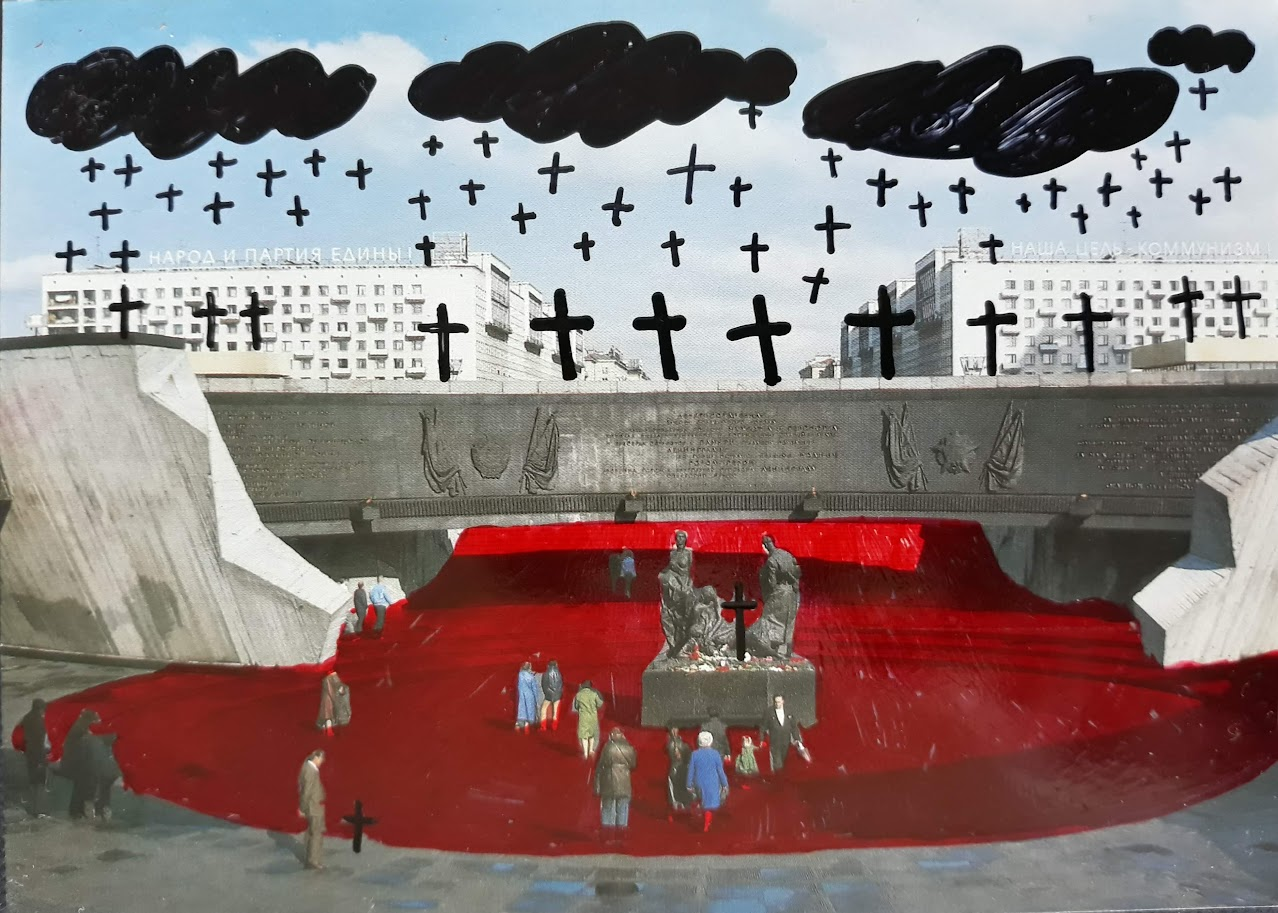
From the series “The Menstrual Blood of Power” (2020), Antanina Slabodchykava
From the series »The Menstrual Blood of Power« (2020), Antanina Slabodchykava
Olga

Moving on to the subject of your art and its visual language. I have noticed that while you constantly experiment across genres, collage remains the medium you return to continuously. Why is that? What draws you to it, and what does it offer you?

ANTANINA

Collage was my personal discovery and what initially caught my attention was its total absence of rulesan anarchy I gladly embraced in the works of nonconformist artists like Timur Novikov and Vladislav Mamyshev Monro, and the early Dadaists. Visually, I was drawn to the spontaneity, eclectism, absurdity, and juxtaposition of the incompatible.


I deliberately turned to collage during my final year at the Academy, when I realized that relying solely on my »favourite« set of tools and imagery was… already a bit boring for me. So, I began incorporating fabric and paper into my oil paintings, before eventually moving on to pure collage and art books containing my own texts.


By the way, my very first art book was a romantic present to my future husband and fellow artist Mikhail Gulin, whom I really wanted to impress with my artistic and literature skills. I think it was exactly then when I fully grasped the potential of collage and the absolute freedom it grants in bringing together colors, forms, textures, and words. To use a culinary metaphor: in art I value spices above everything else! As a spectator, I can appreciate plain, bland art, but I could never create it myself.


At this stage of my career, collage has also become a cornerstone of my teaching practice. I find it to be the perfect tool for introducing people to artit allows students to feel free and, in a good way, unburdened by expectations. While trying collage, students of any age can learn something about themselves before moving to experiments with other media. They feel relaxed and accepted.


I realized this twenty-five years ago when I first began teaching: every child is inherently talented; you simply need to recognize and nurture that potential. I carried that mindset with me when I joined the faculty at Maxim Tank Pedagogical University. My goal was to identify gifted young people and support them. In general, I succeeded in this, though I did clash continually with the Belarusian educational system. I witnessed firsthandthis time from an educator’s perspectivewhat I had experienced as a student: the gap teachers create between themselves and their students, and a total rejection of innovation.


We have spoken earlier about resistance as a central theme in my art, and I bring that exact stance to my pedagogy. I view every student as exceptional, possessing a unique trajectory. As an educator, my job is to help them uncover that potential. Art is how I findand how I am also found by»my« people.

After graduating from the university, I launched an independent practice: a studio within the »Deferred Actions« workshop, where I worked with adults of all ages, who wanted to develop their artistic practice, find their own voice, and discover themselves. Four of those students eventually became professional artists, and together we mounted two major exhibitions.


This year, after receiving a Senate Weltoffens Berlin scholarship, I’m fortunate to continue this work in Berlin in collaboration with »Fem*HUB«, teaching art to displaced female non-artists from Belarus and Ukraine.


Our course, »Collage of Voices. Collective Art in Exile«, is divided into three thematic phases, each concluding with a group exhibition. I meet with Berlin-based women and help them articulate their experiences through art. Art cannot radically alter geopolitical realities, but it can propose alternative ways of interacting with the world and with oneself. And I find this vital. Moreover, these basic physical mechanics of collageworking directly with paper, fine motor coordination, and deep focus on a tangible object right in front of youdo wonders for stabilizing one’s psychological state.


What interests me most about this Berlin experience is also the sense of communityan attempt to create a space where women can share their ideas and thoughts. After all, for almost everyone involved, the context of our presence here is tied to the intense experience of living a completely different life.
Olga

And the last question. What do you lack most in Germany?

ANTANINA

[laughing] I lack most German art collectors! If I had even several of them interested in purchasing and shown my art, this would give me so much relief and relaxation!