»ABC der Ausrufe« (»The ABC of Exclamations«)
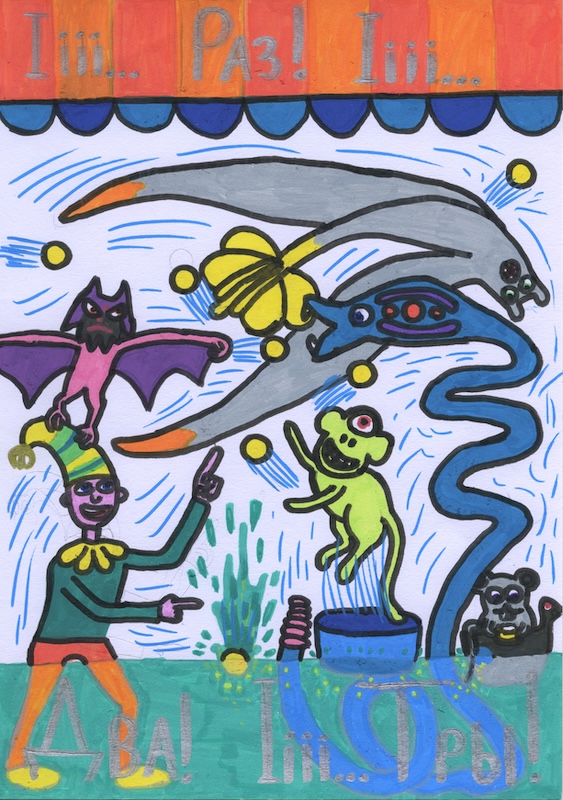
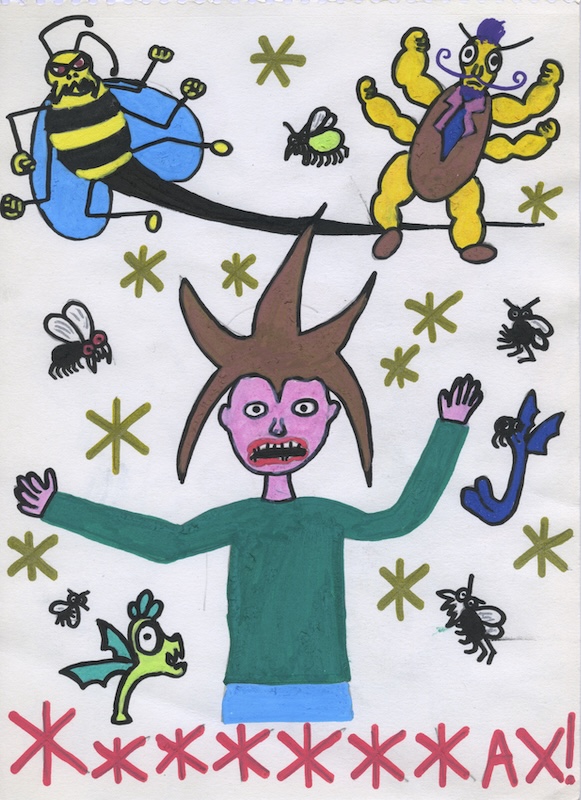
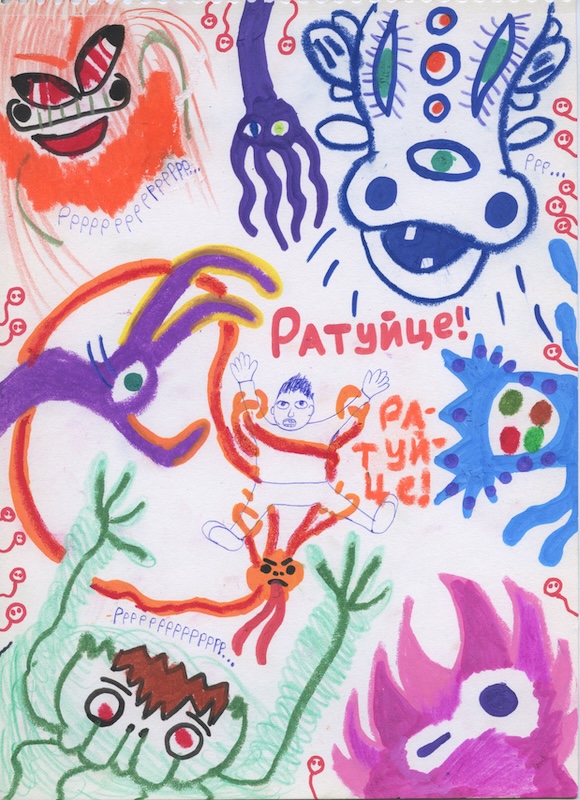
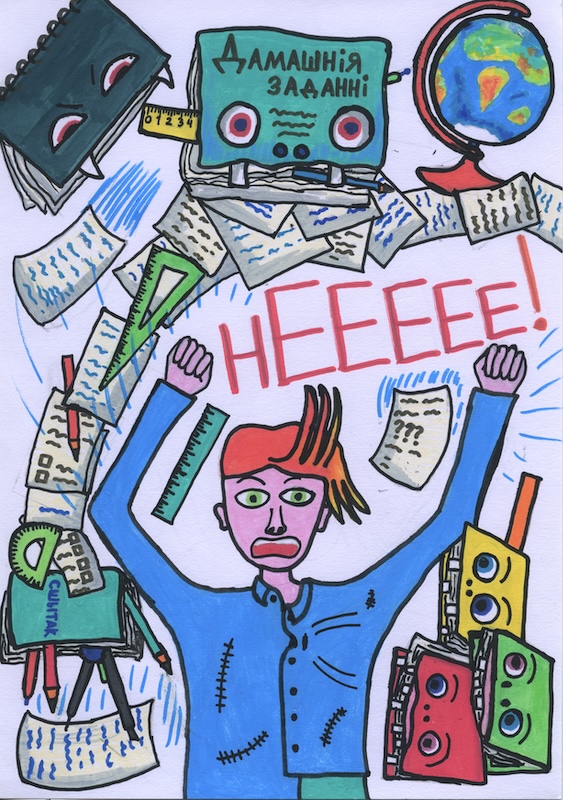
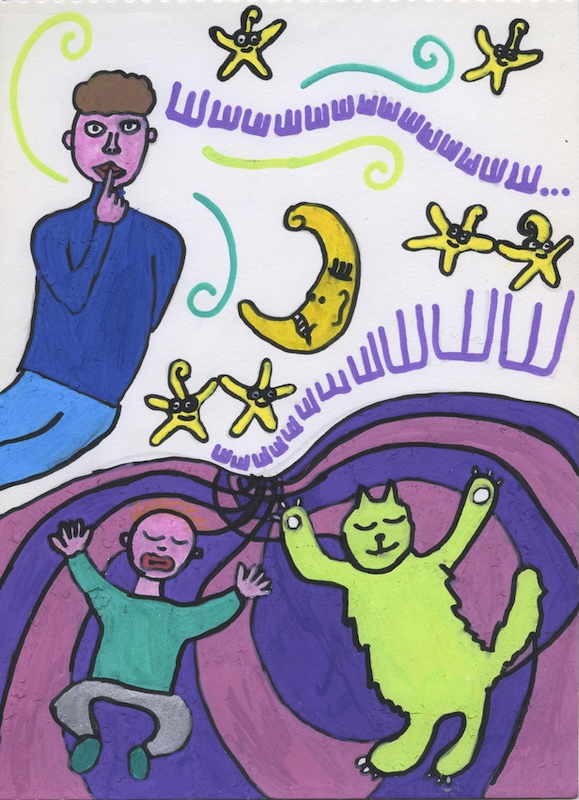
The »ABC der Ausrufe« is an artistic interpretation of the Belarusian alphabet by poet Vera Burlak and her son Kastuś Žybul (19), who lives with autism. For each sound of the 34 letters, the two found an emotional exclamation and transformed these exclamations into 34 stories–fantastic comic drawings by Kastuś, whimsical, funny, enigmatic poems by Vera.
Vera Burlak und the Composer Georgia Koumarà giving an Interview about the work together and the Project.
First of all, I would like to ask you to briefly introduce yourselves. Vera, will you start? Who are you, what do you do, where do you live and where are you from?
I live here in Stuttgart now. And I am a poet and a book editor for Belarusian. And I’ve been taking part in ECLAT as a poet for three years now, in 2022. And now I’m doing a project with my son Kastuś Zhybul, with Georgia Koumará and with Monika Nuber. And that’s very interesting for me because pictures and poems and music and video here come and work together.
You were born in Russia and studied in Belarus? Please tell us a bit about your biography.
No, I was born in Ukraine, in Kiev, then I moved to Belarus, to Minsk, where I lived for a long time. But then I had to move from Belarus to Germany.
Georgia, can you also briefly introduce yourself?
I’m originally from Greece and have been living in Germany for ten years. I am a composer, studied in Cologne and now live here as a freelance composer. And I’m really looking forward to this project.
How did the collaboration between the two of you come about? How did the idea for the project come about?
We got to know each other at ECLAT. Kastuś had the idea of designing exclamations as pictures. People know lots of ABCs, for example for animals or other things. Children are given such ABCs to help them learn the letters and discover the world. Kastuś has now made an ABC about feelings, about exclamations with which we express our feelings. I showed these pictures to Christine Fischer and that’s how the idea of doing this project together came about.
So an ABC of exclamations based on the Belarusian alphabet with 34 letters.
There are thirty-two, plus pictures to go with the greetings »hello« and »goodbye«. Kastuś drew the pictures and I wrote texts to go with them.
Then you come into play, Georgia. So you reacted to the text and image templates?
For me, it was that Christine (Christine Fischer, the Artistic Director of Musik der Jahrhunderte) showed me Kastuś paintings: These are great paintings with very bright colors that also contain a lot of meanings. And I’m very interested in showing this ambiguity of the pictures in the music too. Then there are the poems, which are actually very, very, very deep, not always really suitable for children, I would say. There are dark stories in them. But on the other hand, everything comes across with a great vitality, and I find that very fascinating. There are both worlds: on the one hand you can be playful and childlike, have this cheerful energy, and on the other hand you can also discuss social issues. I find it particularly interesting because the alphabet is the beginning of everything, so to speak. I found it interesting to develop a story together for each of the letters or exclamations in both music and poetry, that was the idea. Then we had several meetings over time to talk about the dramaturgy and how to present the images.
Vera, perhaps you could tell us something about your son who made these drawings: Is he a professional comic artist or draughtsman? Can you introduce him to us a little? How old is he?
He is 19 years old and he has autism. Kastuś was therefore unable to get an education in Belarus. And now we are looking for a way for him to catch up. He wants to be an artist. He likes to paint, has always enjoyed painting and drawing, and now it might become something more. The alphabet of exclamations is Kastuś’s main project so far. He is currently working a lot with Monika Nuber for the video, and it is also very interesting how he does it. He paints and Monika makes the video. [Kastuś is very hard-working and very motivated. That’s very important for me because normally it’s difficult to get him interested in something].
I understand. Now emotions are the issue. We’re talking about exclamations that are used to express emotions. Was that Kastuś’s idea or an idea that came from you? I find it quite interesting, because although I don’t know much about autism, emotional communication is–I believe–certainly very special for autistic people. Hence my question as to whether this idea came from him?
It’s his idea. He has worked a lot with psychologists. When he was a child, he had a lot of lessons on this, where he learned how to recognize and deal with feelings. Autism is a condition where people have difficulty understanding emotions, and he learned it back then. But I also believe that language and expressing feelings is not only very important for autistic people. In our country, it is also a problem to express feelings, because as children we always heard from our parents, our teachers: »You don’t have to express your feelings, you have to work, you have to learn. Your feelings are not important!« And I believe that this is a problem for post-Soviet people in particular. That’s why this work is also a kind of lesson for me in expressing feelings.
Very nice. This idealistic content dimension now also refers to very serious political backgrounds and the experiences in your home country, or rather: your home countries. The question would be whether one could perform your work in Belarus without immediately expecting political repression? Or is it more of a subversive work that you are doing? What would happen if the play were to be performed in Belarus? A serious question, of course.
At the moment, every small protest in Belarus is big. People who did something small in 2020 now have a lot of problems, courts, prison, fines, etc. Even a like on social networks can be a reason to go to prison. People are arrested and have a lot of problems. Our family also had these problems. But we felt that we couldn’t keep quiet. We can’t do nothing. For example, we felt the need to write letters, and many people–for example, certain professional groups at the universities–wrote letters against many different things in Belarus that were not right. So, of course, we revealed our identity, and we couldn’t hide. We had to show our faces, give our names. But now our administration knows about it, they know us. So for many people it is dangerous to stay in Belarus. Many people cannot be active, journalists, for example, or actors or poets. And so on. These people are either condemned to do nothing in Belarus, or they leave Belarus and do something somewhere else.
Georgia, I imagine it’s a great challenge to take these emotions as the basis for a musical composition. I know we don’t want to give too much away, but can I ask if you draw on existing music or sounds or if you create the music from scratch, and how you refer to different emotional qualities of the lyrics?
When I saw the pictures for the first time, I was almost immediately moved by the wealth of emotions. But in the end, what is art if not an expression of emotions? I then thought a lot about how to work with these emotions, also with the lyrics, in order to bring everything together into a balance. Of course, there is also purely electronic music, but also recorded voices with the poems. Then, of course, there is also the question of how to translate a certain color musically–because there are many pictures in which a certain color comes to the fore, as well as poems in which a letter with its specific sound is very present. There are also memorable stories for each painting. I worked with all these factors.
I wanted to ask you once again, Georgia: In Vera’s work, it became very obvious, very clear how strongly the perception and reflection of social life also shapes her artistic work. Is it the same for you? Is this aspect important for your artistic work or is it more the case that you create spaces that are intended to be, want to be, detached from everyday reality? Or how can you describe this for yourself?
Of course, as a person, I am part of society. And of course I am inspired by things that happen in society. I can’t say that I’m going to make art and then be completely removed from reality. I’m interested in and inspired by a lot of topics, especially politics and society. I’m also very interested in how the human brain works. You often think you know how it works because you have one yourself… But every brain is really different and I find it very important for my work and also in general to show different perspectives on this world and make them visible: how differently people think, feel and communicate. These are topics that fascinate me more and more the more people I meet. Everyone thinks differently, everyone communicates differently, everyone has a different interpretation of something. I find that very exciting. It’s something that interests me a lot in my artistic work in general, but also when I’m in the audience myself. The question always arises: how does the person who created something like this think and what did they want to say with it?
I have the feeling that your work has a lot to do with play and pleasure, but also with the seriousness of the game, with protest and rebellion. Vera, how great is your hope that you can change society a little with plays like these? How great is your hope that these autocratic systems in the post-Soviet space will disintegrate at some point? What is your current state of mind?
Especially in a time of war, I think people need to do everything they can to preserve and love the world. The world is not strong, it is something very, very soft! And we shouldn’t wage wars, we shouldn’t be aggressive. We must love instead of being afraid. And I think it’s very important to make art, no matter what, with whatever. We write poetry, we write, we compose music, we do something performative, we play. And that, I believe, is our protest against war, for example. And we have to remain creative and loving. That’s very important to me. And this project is also part of this great work.