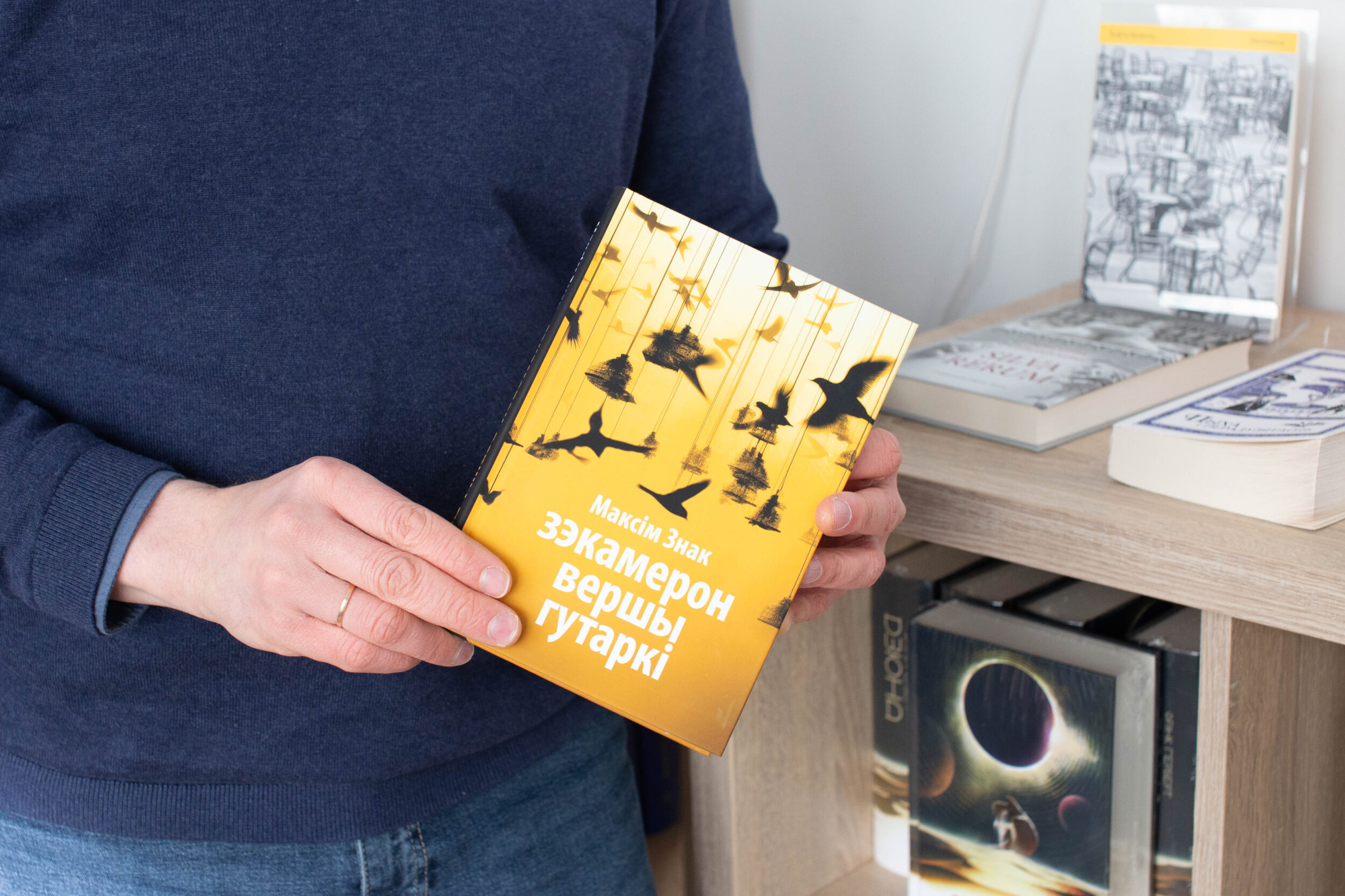
I’m joking! I didn’t go to the Linguistic University and entered the Law Faculty of Belarusian State University instead. But I’ve always had a feeling for language, and prison helped me develop it to a higher level. I had a lot of free time, and I was lucky to be sent to »Vitsba«–a penal colony where they send foreign citizens: for example, foreigners who committed crimes in Belarus or entered the country with a few grams of marijuana. Finding themselves in »Vitsba,« they quite often had books with them. Moreover, books in many different languages were available in the prison library, and I was again lucky enough to be able to read in ten languages while I was there, although I certainly don’t speak all of them fluently.
I read in Belarusian, Russian, Ukrainian, and Polish (which felt natural to me, despite the fact that I had never studied it–it was quite easy to understand), as well as English and German. I studied German a bit at school, but as it was our second foreign language, we didn’t pay much attention to it. It used to be enough for me to say, »Ich heiße Maxim und ich spreche Deutsch nicht«–that got me by in all life situations. But in prison, I took a small German course with an inmate interpreter in the neighboring barracks. Every morning, we had a chance to hold conversations while walking around different local areas, and he also gave me exercises. So, for a couple of months, I enjoyed a daily 15-minute German practice.
Later, in a prison cell, I found myself in the company of Erich Maria Remarque and Franz Kafka, as well as non-German authors translated into German–about 18 to 20 books in total. In English, there were more than 50 books. And then there was this game: whenever I had a chance to get a grammar book or a dictionary in a foreign language, I would study it for a month or so just to understand its structure, parts of speech, and memorize about 90% of the most common words. Then, I would immediately start reading–just like that, without preparation. Usually, it worked well.
My plan was to read as much as possible without going into details. That meant if I understood the general idea of a sentence, I didn’t look up all the new words. I just trained my neural network that way. While reading the first few pages, I would look things up in the dictionary, but by the last 50 pages of a book, I almost never consulted it.
Then I studied a bit of French–mostly written rules, not listening practice. It’s funny: I can’t speak French, nor can I distinguish French words when I hear them spoken, but I can read in French better than in German because I’m more familiar with French grammar and vocabulary, as they are closer to English. Then in Spanish, I read an Abraham Lincoln biography, a strange book about Caribbean rituals… well, that was what I found in the library!… and One Hundred Years of Solitude–I should say that out of the three, it was the hardest. Luckily, I also had the Russian translation to double-check against. In Italian, I read Dante and some poetry, and in Portuguese, a collection of Brazilian anecdotes. But all this stopped in the autumn of 2024, when they burned all the books containing foreign characters and several Belarusian books: Uladzimir Karatkievich, Vasil Bykaŭ, Sviatlana Alexievich, and even the classic Belarusian poet Yanka Kupala, who was said to »write lyrics for Mikhalok.« [an absurd state accusation linking the 20th-century poet to Siarhei Mikhalok, the frontman of the iconic anti-authoritarian punk-rock band Lyapis Trubetskoy–platformB comment]
So, I personally find languages exciting because when you learn a language, you enter a world that isn’t yours, learning new words… Out of curiosity, I also learned Finnish and Norwegian grammar, as well as Arabic and Hebrew scripts. For a while, I kept myself busy with these small and big linguistic discoveries, which I shared daily in notes and letters to my relatives. But I never sent them–they kept disappearing due to my incommunicado status. So all of them, along with my manuscripts, were left behind there.
Languages have a special meaning for me, and I used to dream that when I got free, I would focus on bringing my knowledge of these languages to a high level–moving beyond intuitive reading toward fluent use. And I am sure that in any language–including those you mentioned: the language of law, literature, poetry, and music–you remain the same person. I approach each of them as an instrument of self-expression. I don’t want to be consumed by languages. For example, there is prison slang, or argot, and many people use it daily and start to be driven by the concepts underlying it. I always consciously avoided using it, though you might find some argot words in my writing. My characters speak a semi-normal language with argot elements (about one word out of ten) to highlight something when necessary, but without switching to it completely. Otherwise, the reader would need a specialized dictionary to understand what they are talking about.